We have had a dedicated sustainability programme since 2006, covering our products, supply chain and operations. It is a process of continuous improvement in both the social and the environmental impact of our products. Take a look at our Sustainability Milestones Overview to see some of the highlights throughout that ongoing journey.
Strategy and Reporting
SUSTAINABILITY STRATEGY
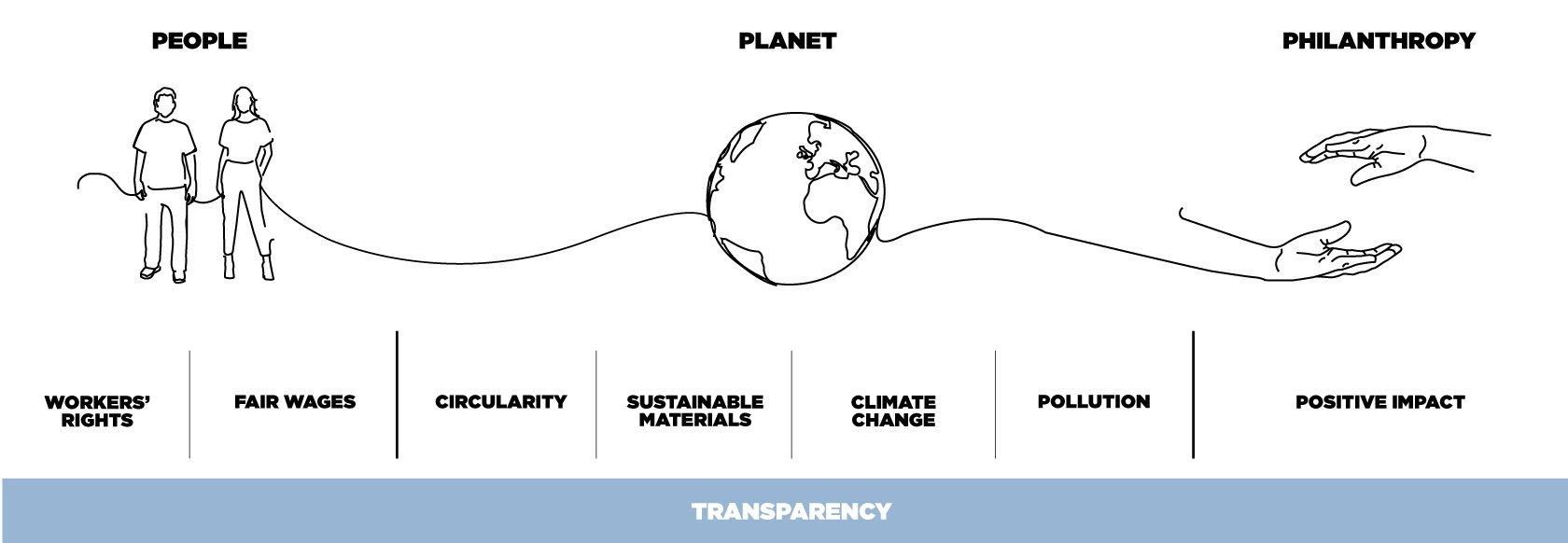
Our approach to sustainability has evolved and improved over the years, our long-term focus includes key sustainability priorities specified in goals for 2025 and long-term ambitions for 2030. These are commitments built on many foundations, such as our risk assessments covering the different phases of our value chain and the use of sustainable materials in our collection. Working with different industry partners and tools such as the Higg Index (Cascale, formerly the Sustainable Apparel Coalition) and the programs of Zero Discharge of Hazardous Chemicals with our suppliers, has ensured that we can measure and track impact, and scale across our value chain. We report annually on our progress and achievement through the G-Star RAW Sustainability report. Read our Sustainability Report of 2025.
Strategic framework
Risk Assessment
To better understand the potential risks and impacts, we assess them across the lifecycle stages of our garments. We also assess each of our production countries based on their national regulations/laws, cultural, social and economic challenges.
This is why we make assessments aligned with the OECD Due Diligence Guidance for Responsible Supply Chains in the Garment and Footwear Sector, as reflected in our Sustainability Strategy, Supplier Code of Conduct, Sustainable Supply Chain Handbook, Social and Labor Guidelines and our Modern Slavery and Human Rights Due Diligence Statement (see downloads).
Governance
Our Sustainability Department implements the Sustainability Strategy within and beyond our own operations. The team specializes in social and environmental sustainability across the supply chain and has a presence across the Netherlands and Asia. An important company focus is to further integrate our sustainability work throughout our organization. The departments that are actively involved in carrying out our sustainability strategy include Design, Product Development, Merchandise, Purchasing & Pricing, Quality Assurance, Sourcing, Logistics, Marketing, Communications and Sustainability.
Partners
- ACT (Action, Collaboration, Transformation)
- ACCORD on Fire and Building Safety in Bangladesh
- Better Cotton Initiative (BCI)
- Dutch Agreement on Sustainable Garments and Textiles (AGT)
- Plastic Soup Foundation
- Social & Labor Convergence Project
- Sustainable Apparel Coalition (SAC)
- Textile Exchange
- UN Fashion Charter
- Zero Discharge of Hazardous Chemicals Initiative (ZDHC)
REPORTING AND TRANSPARENCY
To deliver on our strategy, we enable external stakeholders to hold us accountable when it comes to assessing our data-backed sustainability performance. This includes transparent reporting.
Our first sustainability scorecard was developed with MADE-BY in 2013, and we progressed to a MODE tracker disclosure in 2015 until 2017. Since 2018 we have reported using the Higg Brand and Retail ‘Beta’ Module (BRM).
Since 2020 we annually publish a Sustainability Report that follows the OECD Due Diligence Guidance for Responsible Supply Chains in the Garment and Footwear Sector.
Our latest Sustainability Report focuses on the sustainability progress made in 2025, the planned actions for 2025 and our long-term goals and ambitions for 2025 and 2030.
Providing oversight of the supply chain is part of our commitment to the apparel sector’s Transparency Pledge. Since 2014, we have made our Manufacturing Map public – so anyone can trace the origin of a G-Star product, now covering approximately 95% of our production volume (this differs per season). In addition to the map, we publish further detail on our direct suppliers, processing facilities and nominated fabric mills in our Manufacturing List, which is available on Open Supply Hub (formerly the Open Apparel Registry), an open source tool that maps garment factories worldwide.
Downloads
G-Star Sustainability Report 2025(pdf/41.1MB)
Sustainability Milestones Overview(pdf/345KB)
G-Star RAW Manufacturing List(xlsx/65KB)
Transparency Pledge(pdf/435KB)
All Available Downloads
Scope Certificate OCS GRS RWS(pdf/828 KB)
Material Risk Assessment(pdf/133 KB)
G-Star Sustainability Report 2024(pdf/1.5MB)
Sustainable Supply Chain Handbook(pdf/702KB)
Environmental Guidelines(pdf/1.53MB)
Social and Labour Guideline(pdf/1030KB)
G-Star RAW Manufacturing List(xlsx/75KB)
G-Star Raw Supplier Code of Conduct 2023(pdf/371KB)
The most sustainable jeans 2018(pdf/1,0MB)